
What makes switches luxury quality: light switches guide
13 May 2026
Elegant switches for home design: a designer light switches guide
18 May 2026Specifying contemporary light switches and sockets first requires the backplate tolerance to be precisely aligned to the wall construction. This element is frequently underspecified, even though it forms some of the most engaged surfaces in an interior. The following material guidelines clarify the concrete distinctions between brushed metallic frames and solid brass mechanisms. In practice, the decision turns on material behaviour, not catalogue descriptions.
Choosing the best contemporary light switches and sockets
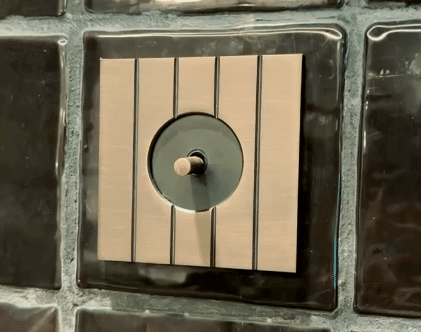
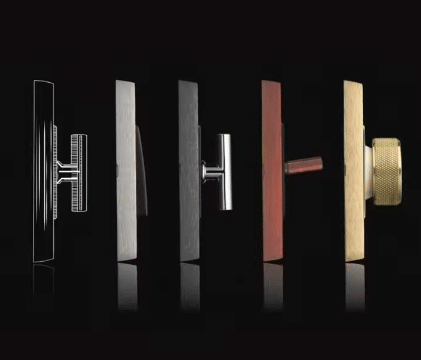
Satin gold develops a different patina to brushed gold under identical artificial lighting. That physical reality dictates the finish strategy for a south-facing elevation. Furthermore, specifying rocker switches over toggle switches impacts the required backplate depth and alters the permissible electrical rating. Understanding these technical separations is essential.
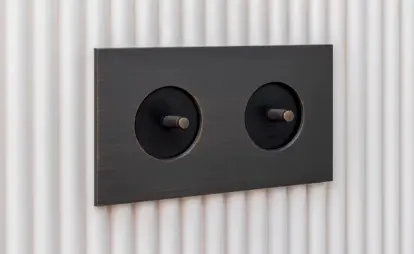
Why light switches matter in modern interior design
A standard plastic plate installed beside a calibrated skirting profile creates an immediate visual contradiction. The weight and frame geometry of light switches register at close range. I would specify these components with the same strictness applied to architectural door hardware.
- Visual frequency: These mechanisms sit at exact hand height, rendering their finish as critical as the adjacent architrave.
- Tactile quality: The mechanical resistance of a toggle or the specific travel of a press-key fitting registers instantly upon use.
- Finish coherence: A brass frame that contradicts the tapware in an adjoining bathroom creates an unresolvable discontinuity once the joinery is fixed.
In practice, replacing a metallic mechanism post-installation is rarely viable. The specified finish must withstand cleaning agents and ultraviolet exposure over two decades. Ageing behaviour forms a central part of the selection criteria.
I would determine this finish simultaneously with the bathroom brassware, never as a late-stage addition. The architectural hardware and electrical fittings require a unified material logic. This ensures coherence across the entire hardware schedule.
Top finishes for contemporary light switches and electric sockets
The palette for designer sockets and switches extends beyond standard matte white to include fourteen distinct metallic options. The decision to specify electric sockets in dark bronze or glass relies strictly on anticipated patina and proximity contrast. The final choice must anticipate how the material will age.
- Brushed brass: This unlacquered metal naturally darkens at the primary contact points within eighteen months. For environments requiring enduring uniformity, a lacquered alternative from Fede Switch & Light stabilizes the surface.
- Satin nickel: This alloy repels fingerprints effectively and remains stable under continuous maintenance. I would specify nickel for mixed interior schemes requiring a neutral metallic transition.
- Antique brass: Manufactured with a pre-aged surface, this finish delivers immediate tonal consistency. It performs correctly within heritage properties where natural patina development is not desired.
- Matt black: This treatment provides stark graphic contrast but readily exposes surface marks under raking light. I reserve it strictly for projects demanding deliberate visual interruption.
Paintable flush plates eliminate the metallic reference entirely, suiting minimal architectural schemes. However, future room redecoration mandates precise repainting of the surrounds. The final quality ultimately depends entirely on the decorator.
Brushed nickel and metallic options for designer light switches
Brushed nickel occupies a precise thermal space between polished chrome and satin gold. I would specify this finish when a client requires chrome sockets in wet rooms but prefers a warmer reading in corridors. A high-quality mechanism guarantees consistent brush direction across the double-gang designer sockets.
Brushed chrome presents a severe, industrial aesthetic at close range, suiting concrete partitions. Conversely, bronze sockets and dark pewter tones ground a room visually against extensive timber joinery. I would specify these heavier metals where a lighter contemporary finish might appear unanchored.
| Finish | Warmth level | Patina behaviour | Best specification context |
| Brushed brass | High | Darkens at contact points over 12–18 months | Residential interiors where ageing is part of the brief |
| Brushed nickel | Medium | Stable; resists fingerprints and cleaning products | Transitional and contemporary residential projects |
| Brushed chrome | Low | Minimal; holds uniform tone over time | Industrial aesthetic or technical interior schemes |
| Antique brass | High | Pre-aged at manufacture; consistent from installation | Period properties and heritage transitional schemes |
| Matt black | Neutral | Shows surface marks under raking light | Minimalist schemes with deliberate graphic contrast |
| Dark bronze / pewter | Medium-high | Stable; reads heavier than brass | Timber-rich interiors and dark-painted wall schemes |
Functional features to look for in modern light switches
Mechanism selection fundamentally alters the electrical rating beneath the chosen finish. Dimmer switches demand exact lamp compatibility checks; an LED dimmer paired with halogen fittings ultimately compromises lamp lifespan. This technical assessment belongs strictly in the initial lighting control specification.
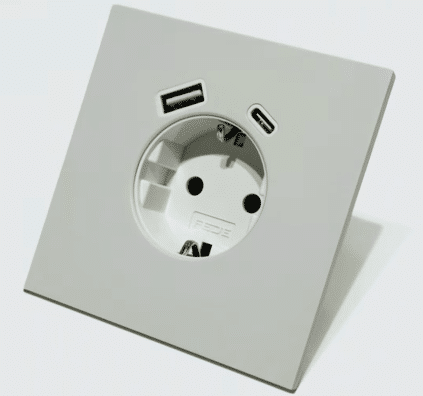
Modern functionality extends to rotary dimmers, a dedicated cooker switch, and integrated usb sockets. Furthermore, specifying cooker switches alongside multimedia terminals allows centralized utility management. Architrave switches resolve tight door reveals, while sockets and switches must integrate seamlessly.
Coordinating light switches and sockets ensures visual continuity across complex wiring configurations. By selecting contemporary light switches and sockets that share a unified aesthetic, the designer properly grounds the space. Ultimately, precision in these details justifies the investment.
Frequently asked questions
What is the difference between designer switches and standard electrical switches?
Standard electrical switches meet basic regulatory compliance and typically use generic white plastic. Designer switches, conversely, are built from solid brass, brushed nickel, or contemporary metal alloys with exacting dimensional tolerances. The core mechanism may be similar, but the difference comes down to material density and the way the piece ages over a twenty-year period.
Which finish works best for luxury sockets and switches in a contemporary interior?
Satin nickel offers a versatile baseline for residential projects, as it resists developing an uneven patina at high-contact points. For material warmth, I would specify brushed brass, provided the client accepts its visible surface evolution over time. Concretely, one must specify luxury sockets and switches alongside all other door hardware at the same project stage.
Are luxury light switches and sockets worth the investment compared to standard fittings?
Luxury light switches are a permanent architectural decision. A solid plate remains fixed for the installation’s lifespan, unlike wall paint, which validates the initial cost across fifteen years. The decision turns on interior coherence at close range, where luxury sockets that perfectly match tap fittings read as considered design, not mere accessories.
I would specify the FEDE+ range to unify a project’s control points. The contemporary metal switches from the MARCO collection resolve transitional briefs that demand precise frame geometry. For artisan surfaces, the brushed brass switches in the SoHo line provide a complete functional set, including decorative light switches, double sockets, and designer plug sockets.
When an ultra-slim profile that integrates with the wall is required, the studio light switches from the STUDIO Collection are the specification I would advance. These light switches and sockets coordinate seamlessly. Every collection incorporates sockets and light switches alongside critical mechanisms like dimmer switches, a dedicated cooker switch, and USB sockets, maintaining a consistent finish logic throughout.