

Decorative switches for interiors: buying guide
22 May 2026
Vintage luxury brass light switches: antique brass buying guide
26 May 2026This guide addresses a question that materials for luxury switches reddit threads return to repeatedly: what separates a solid substrate from a plated commodity alternative. Concretely, a specification-grade brass backplate measures 0.080 inches in thickness, and that baseline matters. The decision between brass, glass, ceramic, and copper dictates both the tactile resistance and the longevity of the installation.
Best materials for luxury switches explained
The substrate of luxury switches governs finish retention and corrosion resistance across a twenty-year service life. Mass-produced mechanisms rely on thin metal veneers that chip away under daily handling, revealing inferior base metals beneath. Understanding this material hierarchy before approving a specification schedule prevents costly replacement cycles.
Why solid brass remains the gold standard
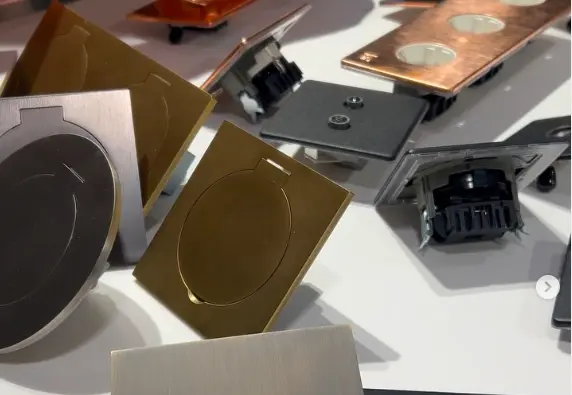
When materials for luxury switches reddit users discuss at length, structural integrity dominates the conversation over visual appeal. In practice, a solid brass plate adds between 400 and 600 grams per gang, which requires appropriate wall anchors during installation. That specific weight is what delivers the tactile assurance of material quality each time the toggle is operated.
- Copper-zinc ratio: A higher copper content yields a softer alloy that accepts fine-grained polishing uniformly, while increased zinc produces a harder, more mechanically resistant substrate.
- Unlacquered patina: Solid unlacquered brass develops a protective oxidation layer through handling, whereas brass-plated zinc degrades to expose grey metal within three to five years.
- Component consistency: Specification-grade hardware uses solid brass across the plate, toggle, and collar alike, ensuring the mechanism wears uniformly across every touchpoint.
Unlacquered antique brass darkens considerably within the first three months of active use. I would specify this finish for historical renovations where accelerated patina development aligns with the architectural brief. The guide on luxury brass switches details how dimensional tolerances and construction quality vary across brushed, satin, and polished configurations.
Premium alternatives: glass, ceramic and enamel
Brass is not the only defensible specification when evaluating the best materials for luxury switches for a given room. The correct material choice depends strictly on the building’s conservation status and ambient moisture levels. The resource covering luxury switch materials demonstrates how aluminium and customisable metal finishes answer more contemporary architectural demands.
- Genuine porcelain and ceramic: This vitreous substrate offers high thermal stability and remains the primary specification for early twentieth-century restorations bound by strict conservation guidelines.
- Tempered glass: High-reflective glass in stark white or deep black introduces architectural depth, while transparent acrylic allows specialist wall coverings to remain visually uninterrupted.
- High-intensity enamel (SMALTO ITALIANO): Fired in traditional kilns, this finish guarantees precise colour matching and high surface hardness for projects demanding strict visual uniformity across multiple zones.
- Natural overlays: Wood veneer, leather, and stone integrate the switch plate directly into bespoke joinery schemes, a requirement frequently encountered in premium hospitality interiors.
Solid copper is a highly reactive substrate: it oxidises into a deep red-brown, diverging sharply from the golden tones of brass. I would specify solid copper exclusively for industrial interiors or eclectic spaces where the material’s evolution is an explicit project requirement. In those contexts, the mechanism reads as a deliberate craft object rather than background hardware.
To evaluate how these switch materials withstand daily mechanical stress across distinct environments, understanding the manufacturing process is essential. The technical breakdown of luxury switch materials addresses how hydraulic die stamping and hand polishing determine whether a surface holds its integrity over a fifteen-year cycle.
How finishes and patina affect long-term performance
The decision between a lacquered and an unlacquered surface dictates whether the mechanism retains a uniform appearance or develops individual character through handling. Fede Switch & Light mills fourteen distinct surface treatments across its brass collections, separating finishes by their oxidation profiles. For commercial environments where visual consistency is non-negotiable, I would specify the lacquered variants without hesitation.
Satin brass uses a protective lacquer that halts oxidation entirely, making it the appropriate choice for minimalist schemes where surface stability is a priority. Unlacquered antique brass, aged by hand during production, continues to deepen unevenly around the toggle over the first few months. Concretely, that uneven darkening is proof of material, not a defect.
| Finish | Lacquered | Patina development | Best suited to |
| Polished brass | Yes | None | Classical and formal interiors |
| Brushed brass | Yes | Minimal | Modern and contemporary schemes |
| Satin brass | Yes | None | Minimalist and neutral interiors |
| Antique brass (unlacquered) | No | Significant within 3 months | Period, heritage and historical renovations |
| Brushed copper | No | Deep red-brown over time | Industrial and eclectic warm-toned interiors |
| Graphite / milled graphite | Yes | None | Stark monochrome and Brutalist schemes |
| Matte black | Yes | None | Contemporary and high-contrast interiors |
Matching materials to your interior and environment
Environmental constraints dictate material selection well before visual preferences come into play. Enclosed bathrooms subject hardware to continuous moisture loads, making vitreous glass or polished chrome the most technically defensible choices. Stark monochrome schemes, by contrast, benefit from the cool tones of milled graphite; a warm-toned metal would introduce unnecessary visual friction.
For a heritage renovation, I would specify unlacquered antique brass on a solid plate, allowing the natural patina to ground the mechanism within the architecture. In a contemporary new-build with tall ceilings and a restricted palette, a matte black or lacquered brushed brass finish represents a more honest specification. What changes here is the priority: the mechanism must perform reliably without competing with the surrounding elevation.
Frequently asked questions
What is the best material for luxury light switches in a residential project?
Solid brass machined to a thickness of 0.080 inches remains the baseline standard for premium switch materials. A backplate of this gauge adds between 400 and 600 grams per gang, ensuring structural rigidity while allowing a natural patina that plated metals simply cannot replicate. For period restorations, I would specify unlacquered antique brass; for contemporary briefs, lacquered brushed brass delivers the necessary uniformity.
Are there alternatives to brass for high-end switches in listed or heritage buildings?
Authentic porcelain and ceramic backplates represent the most rigorous specification for listed restorations, frequently passing conservation audits where standard metal plates face rejection. Kiln-fired enamel is a viable secondary route, offering considerable surface hardness alongside precise colour calibration. Concretely, the architectural context dictates the mechanism housing long before any specific finish enters the conversation.
How do I match switch materials to the rest of my interior hardware?
Installing brass toggles alongside chrome socket outlets compromises the visual coherence of an entire interior elevation. In practice, the decision turns on establishing a single finish logic and applying it rigorously across all switch materials, electrical mechanisms, and backplates. For hospitality projects and bespoke joinery, Fede Switch & Light’s Marco collection permits exact RAL and Pantone matching, effectively eliminating this coordination variable.