
Will brass taps go out of fashion in your bathroom?
8 June 2026
Top luxury light fixture brands for designer lighting
10 June 2026
Visual and style differences between chrome and brushed brass
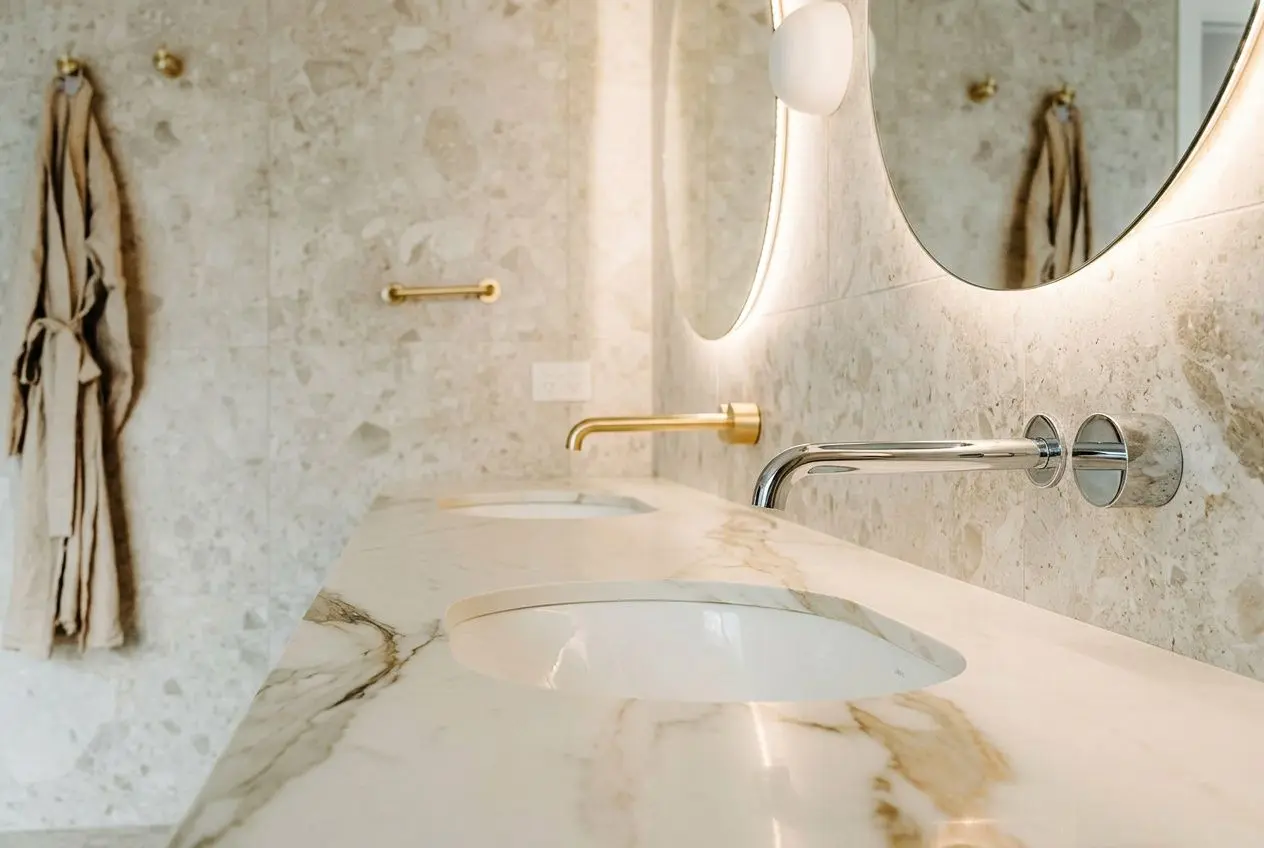
It sets the visual language of the room, deciding whether the scheme feels crisp and restrained or warm and composed. The distinction lies in what the interior is already asking for: a cool, reflective scheme points towards chrome, while a palette built on warm stone or timber makes brushed brass the more considered starting point.
Chrome finish: reflective, minimal, and timeless
The chrome finish offers a mirror-bright surface with a clean, precise presence. In the difference between chrome and brass taps, chrome is valued for versatility: its cool neutrality works with white sanitaryware, stone surfaces, and contemporary grey tile alike.
Polished chrome also reflects light effectively, which makes it especially useful in compact bathrooms with limited daylight. Beyond this, its consistency across ranges helps coordinate basin taps, showers, and accessories with a disciplined visual line.
- Light reflection Chrome brightens smaller rooms and can make them feel more open.
- Design compatibility Chrome taps sit comfortably in minimalist, Scandinavian, and traditional interiors.
- Finish uniformity Classic chrome remains relatively consistent across manufacturers, helping coordinate basin taps, showers, and accessories.
- Mark visibility Water spots, fingerprints, and smears are more visible on polished surfaces, so regular maintenance matters.
That clarity gives chrome lasting relevance in projects where materials may shift over time. The right choice when flexibility matters, it rarely competes with surrounding finishes and sits comfortably beside stainless steel details elsewhere in the scheme.
Brushed brass finish: warm tones and tactile texture
In contrast, brushed brass taps are created by abrading the surface with fine materials to form delicate parallel lines. Light is diffused rather than sharply reflected, and the finish takes on a warm, velvety character that suits marble, stone-effect tiles, cream joinery, and muted natural palettes.
Once warmth has been established in the room, brushed brass can give a bathroom a more layered and tailored atmosphere. Polished brass, by comparison, appears more decorative and overt; brushed brass is usually better suited to refined luxury interiors where texture matters as much as colour.
Which finish suits your bathroom style best?
The finish determines how the whole scheme is read. Chrome supports a timeless, clear-lined look that works well with frameless enclosures and pared-back forms, while brushed brass draws the palette towards warmer stone, timber, and textile choices.
Provided that the wider material palette is coherent, both finishes can be highly resolved. Chrome is often the right choice when flexibility is needed across changing styles; brushed brass is more persuasive when the brief calls for warmth, depth, and a clearly defined material story.
The same principle applies when other tap finishes are already in play, whether matte black, stainless steel, or a mix of metal accents across adjoining rooms. FEDE Switch & Light approaches this balance with the precision of a Spanish artisan manufacturer, where heritage craft is carried into contemporary interior design projects.
- Minimalist and contemporary Chrome remains highly coherent in cool or neutral schemes with clean geometry.
- Hotel-style interiors Brushed brass works especially well with layered textures, warm stone, and soft neutrals.
- Period renovation Both can succeed, though brass often feels more sympathetic to heritage settings.
A considered approach to tap finish selection looks beyond the fitting itself: wall tiles, basin material, cabinetry, light levels, chrome finish detailing, and whether chrome taps or brushed brass taps will better conceal water spots in a hard water area all shape the final result. Once selected with care, the finish supports not only visual coherence but also the long-term ease of the space.
Durability, maintenance, and hard water performance
In a bathroom tap, the finish determines long-term value: durability, resistance to corrosion, limescale, and routine cleaning all shape how well the piece performs in daily use.
Material strength: solid brass vs chrome-plated fittings
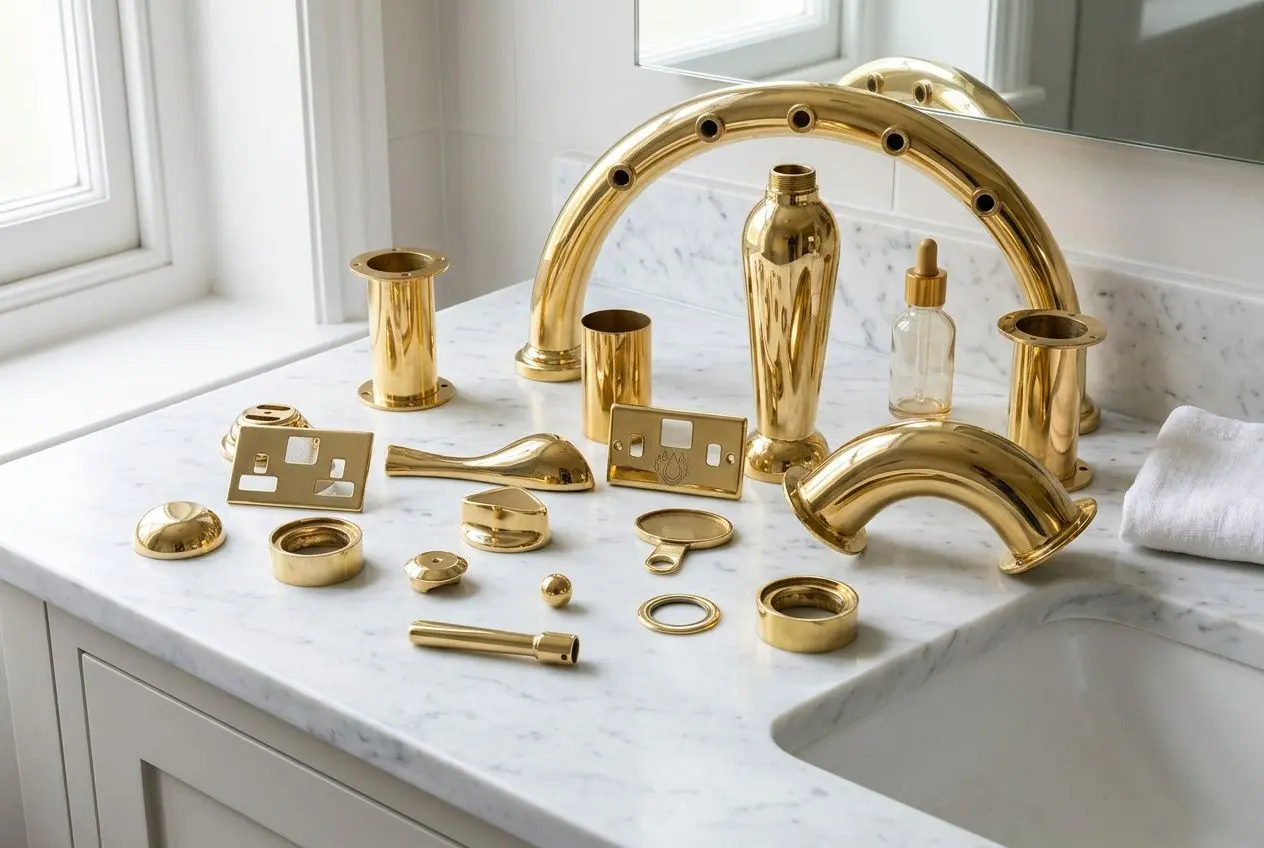
Brushed brass bathroom taps are made from solid brass, a copper-and-zinc alloy valued for its corrosion resistance and an expected lifespan of 10–15 years or more in normal bathroom conditions.
In contrast, chrome-plated fittings rely on a surface coating applied over brass or mild steel. This layer typically lasts around 5–7 years before scratching or peeling may appear, which clarifies an essential part of the difference between chrome and brass taps: in solid brass, the material itself carries the quality, rather than a finish masking a lesser substrate.
Modern brass used in UK bathrooms meets current safety standards and contains no lead, a baseline FEDE Switch & Light treats as non-negotiable in specification. For contemporary interior projects, this structural integrity remains central to both performance and longevity.
Brushed brass and chrome in hard water areas
Against that construction background, daily performance becomes easier to judge. In practice, the difference between chrome and brass taps bathroom settings show most clearly in hard water areas, where mineral-rich supply leaves limescale deposits regardless of water quality.
Brushed brass handles this visually with greater discretion. Its matte, textured surface softens the appearance of early deposits, while polished chrome reflects light more sharply and makes scale, splashes, and residue more apparent.
Beyond this, protective lacquer or specialist treatments can improve the resistance of brass finishes to mineral marking. A considered approach to specification often favours brass where build-up must remain less visible between cleaning intervals.
Day-to-day cleaning requirements for each finish
That visual behaviour carries directly into upkeep. Chrome usually asks for more frequent cleaning, since watermarks and fingerprints show almost immediately on a reflective surface, whereas brushed brass is more forgiving between wipes.
- Chrome care: Buff with a soft cloth and mild soap after use; the surface recovers quickly, but marks reappear readily.
- Brushed brass care: Clean with a soft cloth and mild soap; avoid abrasive pads and harsh products that may damage the matte surface or protective coating.
- Descaling caution: Diluted white vinegar is suitable for chrome only; it should not be used on brushed brass or other coloured brass finishes.
Provided that maintenance is gentle, both finishes can age well. A brass finish may develop a subtle patina through oxidation over time, while chrome tends to retain a more consistent appearance for as long as its coating remains intact.
Once selected, each finish expresses a different priority in daily use: Chrome delivers a consistently bright surface; brushed brass offers material depth and greater discretion where limescale and visible wear are ongoing concerns.
Cost, long-term value, and buying considerations
Service life, replacement cycles, maintenance demands, and the cost of keeping a full scheme visually coherent all shape the real value of a bathroom tap or kitchen fitting over time.
Upfront cost vs long-term investment
From the outset, the difference between chrome and brass taps is most visible in price. In kitchen settings and bathroom specifications alike, polished chrome is often the more accessible choice: its surface coating is less costly to produce, and it remains the standard option in many projects.
That lower entry price reflects a thinner surface coating rather than a difference in core construction, a distinction that becomes consequential as the fixture ages. Brushed brass usually carries a higher initial cost, yet the distinction lies in lifespan: quality solid brass construction, paired with a well-executed brass finish, tends to deliver stronger long-term value.
- Chrome lifespan: typically 5–7 years before the coating may degrade, peel, or show scratches clearly.
- Brass lifespan: solid brass fixtures commonly perform for 10–15+ years with standard care.
- Price gap reality: the gap between mid-range brass and premium chrome is often narrower than expected.
In practice, durability changes the calculation. Where budget allows, brushed brass bathroom taps often prove the more economical specification over time, particularly in areas affected by hard water, where marks and wear tend to show more readily on chrome.
| Consideration | Chrome | Brushed brass |
| Upfront cost | Lower | Higher |
| Expected lifespan | 5–7 years | 10–15+ years |
| Mark visibility | High | Low |
| Hard water tolerance | Lower | Higher |
| Long-term value | Moderate | Strong |
| Finish matching ease | High (uniform across brands) | Variable (tone differs by manufacturer) |
Matching brushed brass fixtures across your bathroom
That longer view of value leads directly to specification. When selecting brushed brass bathroom taps within a broader bathroom scheme, the finish determines how easily the room holds together: unlike chrome, brass tones and brushing can vary noticeably from one manufacturer to another.
Worth specifying here: samples matter. A tap, shower control, towel rail and accessory set should be checked side by side, under the project’s actual light, so that every element sits within the same visual family.
Beyond this, FEDE Switch & Light supplies electrical accessories in a single brushed-brass tone across its range, allowing tap hardware and switching to be specified with far less risk of tonal drift. For interiors where precision matters, that consistency supports a more resolved bathroom scheme.
Provided that the finish has been chosen with care, brass ages with more character than chrome. While chrome tends to remain visually stable, brushed surfaces can deepen subtly over time, giving a carefully chosen brass specification a quieter sense of permanence.
Frequently asked questions
Is brushed brass or chrome more durable for bathroom taps?
For a bathroom tap, the distinction lies in the material itself: solid brass offers greater structural durability than fittings that rely on a chrome coating. Brushed brass taps commonly deliver a lifespan of 10–15 years or longer, while chrome-plated models often show wear after 5–7 years as the surface begins to deteriorate.
In contrast, polished chrome can scratch, dull, or peel as daily use takes its toll, whereas solid brass retains its integrity more consistently. For projects where longevity is the priority, brushed brass is generally the stronger specification.
Are brass taps more expensive than chrome?
That longer lifespan naturally affects value. Brushed brass taps do usually cost more upfront than chrome, yet the gap between well-made mid-range brass and premium polished chrome is often narrower than expected.
Beyond this, a considered approach to cost looks at the full service life: over 10–15 years, brass can prove more economical because it reduces replacement frequency.
Which tap finish is easiest to keep clean?
Once selected, the tap finish will shape day-to-day maintenance. Brushed brass requires less frequent cleaning than chrome because its muted surface helps conceal fingerprints, water marks, and minor wear, while polished chrome reflects light sharply and reveals almost every mark.
In hard water areas, brushed brass also disguises early limescale more effectively. Both finishes should be cleaned with a soft cloth and mild soap: abrasive products are unsuitable for either, and vinegar should only be used with care on chrome, never on brushed brass.